

TM 5-3805-294-23-1
0003
HYEX THEORY OF OPERATION - Continued
Engine Operation - Continued
Oil from the piston cooling orifices sprays on the underside of the piston to keep the piston crown (Figure 5, Item
46) cool. The oil spray also provides splash lubrication for the piston pin and bushing (Figure 5, Item 47) by splashing
oil into a hole drilled in the top end of the connecting rod.
At the rear of the cylinder block, oil flows from the rear camshaft bushing (Figure 5, Item 41), up through the cylinder
head and into the rocker arm shaft (Figure 5, Item 48). Oil flows through the rocker arm shaft and lubricates each
of the rocker arms (Figure 5, Item 49). Oil drips from the rocker arms to lubricate the adjusting screws, push rods,
and camshaft followers.
At the front of the cylinder block, oil flows from the oil passage into a machined groove (Figure 5, Item 50) in the
front face of the block. This groove connects with the upper idler gear shaft (Figure 5, Item 51) to provide oil to the
idler gear bushing. The lower idler gear bushing is splash lubricated.
The turbocharger oil supply line (Figure 5, Item 52) supplies oil to the turbocharger from a cross-drilled passage in
the main oil gallery. Oil returns from the turbocharger through the drain line (Figure 5, Item 53).
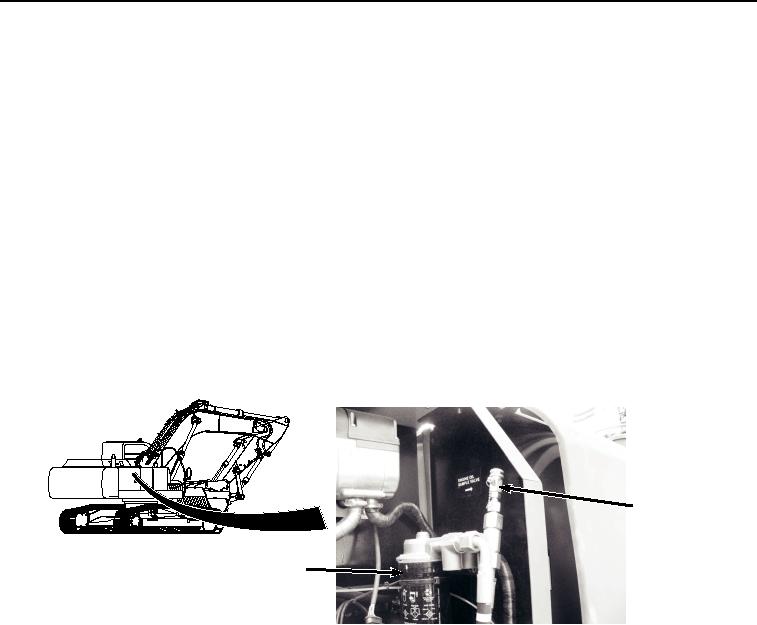
The engine oil filter (Figure 6, Item 32) and sampling port (Figure 6, Item 54) are remotely located in the hydraulic
pump compartment.
54
32
HYEX01680
Figure 6.
Engine Oil Sampling Port.
Engine Electronic Control System
Engine Control Unit (ECU)
The ECU is the controller that follows a defined program to run the engine at the desired operating point while keeping
within emissions regulation. This system is made up of input components (i.e. temperature and pressure sensors),
and controlled components (i.e. injectors and suction control valve). The ECU consists of:
Analog-to-digital converters (A/D)
Digital-to-analog converters (D/A)
Microprocessor (CPU)
Memory (storage)
Internal power supplies for external components
The analog-to-digital and digital-to-analog converters (A/D and D/A) take the analog input information from the
external components and convert it to a digital value that the microprocessor (CPU) can understand. The D/A
converts the digital information from the CPU to analog information that is used by the external components.