

TM 5-3805-294-23-1
0003
HYDRAULIC SYSTEM - Continued
91
90
92
93
89
HYEX01689
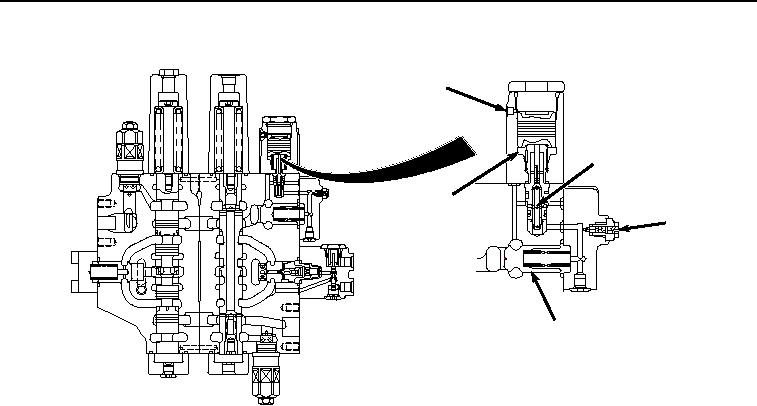
Figure 14.
Boom Reduced Leakage Valve Operation.
When a function is actuated, the pilot pressure from pilot control valve (Figure 14, Item 91) shifts the switch valve
(Figure 14, Item 90). The oil pressure from the cylinder is blocked by the switch valve. The oil pressure at the top
(spring end) of the check valve can now flow through the pilot valve to the air bleed passage in the pilot caps and
then to the hydraulic oil tank (Figure 14, Item 92). The oil pressure from the cylinder pushes the check valve off its
seat, opening the passage for oil to flow into the control valve return passage. The check valve is pushed off its seat
because the OD of the upper land at the head end of check valve is slightly larger than at the lower land.
The manual boom lower screw (Figure 14, Item 93) is no longer used to lower the boom if the engine should stop
with the boom in the raised position. This functionality is now performed at the load holding valves.
Load Holding Valves
The HYEX is equipped with a load holding valve for each boom cylinder. When the circuit is activated, oil passes
through the load holding valves and raises the boom cylinders. When the lifting flow stops the spool in the load
holding valve re-seats the check valve and provides load holding. Under normal conditions, the boom lowering is
controlled by the joystick. Pilot pressure opens the check valve in the load holding valve, allowing a progressive
lowering of the boom. The load holding valves must be released manually in the event of an engine failure.
Main Control Valve
The main control valve consists of two monoblock valves referred to as the left control valve (Figure 15, Item 94)
and right control valve (Figure 15, Item 95). The valves are mounted back-to-back so the oil passages in the valves
are connected. The spools are selectively fitted. There is a spool in each valve to control the boom, arm, and travel
functions. All other functions are supplied by a single spool in one or the other of the valves. All spools are moved
by pilot oil. Check valves are used as lift checks and to route supply oil between the valves for combined operation.
Each valve section controls the flow rate and direction of its hydraulic circuit.